Oral history of music with Khosousi – Conversation of Siavash Nikpay with Bahman Rajabi
Khosousi presents:
A conversation with Bahman Rajabi
Videographer: Alireza Darouki
Sound Recordist: Ramin Pir
This collection is prepared and arranged by Siavash Nikpay and has been provided to us thanks to him.
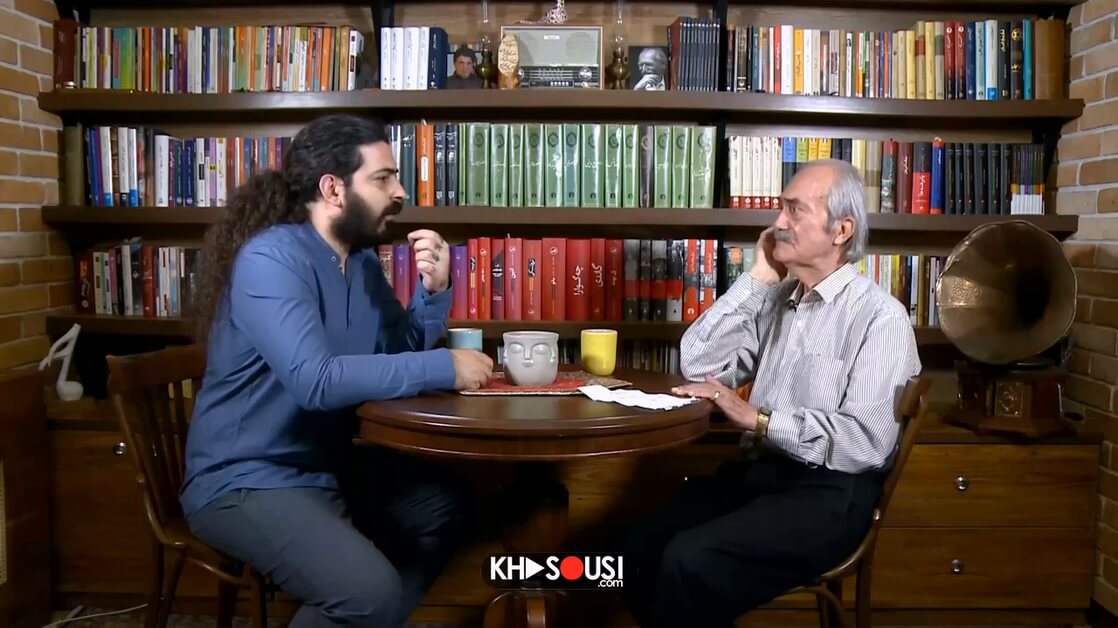
In the fifth and final part of this collection, Siavash Nikpay has sat down with Bahman Rajabi for a conversation.

720p – 575MB : Download from Uploadboy
360p – 184MB : Download with direct link – Download from Uploadboy
Watch Siavash Nikpay’s conversation with Bahman Rajabi online:
Bahman Rajabi, born on March 7th in Rasht, is a stylish player and teacher of Tombak.
One of his famous works in the field of Tombak solo is the piece “Left and Right Dialogue,” which is available in his Tombak training book (Volume 2). Among his innovations in Tombak playing technique is the addition of 11 types of rolls.
With his mother’s support, Bahman Rajabi participated in the classes of Master Hossein Tehrani in 1949, which, of course, did not continue. When he returned from his military service at the age of 22, he continued playing independently and with his own passion and interest. In 1964, at the age of 25, he met the most influential person in his life, the late Amir Nasser Eftetah, and began learning and playing with him. He has always said that he owes his artistic life to Eftetah. Rajabi continued his university studies in agriculture and graduated in the same field. In 1966, he got married and had two sons. He was never an obedient and compliant person like other musicians of his time, and he always expressed his critical views without fear and consequences of the subsequent problems. His personal characteristics did not make him a court musician and artist, and he hated lords and power. He hated hypocrisy and flattery and had a sharp tongue. He studied a lot and was interested in mountaineering.
After the revolution, finally, from March 1989, i.e., from the age of fifty, after years of being away from the world of music, he started teaching Tombak exclusively from his book and personal method, and ten years later he agreed to have it officially printed and published, while before that, his collection of educational pamphlets had been published under someone else’s name! However, the result was astonishing, and in a short time, it reached the fifth edition from the first edition, while other methods and instructions in the art of Tombak playing from past and present masters were abundantly available.
This training book is written using a single-line notation method. There is also a three-line method in Tombak playing, but in Rajabi’s method, the situation is different. His first book is educational, and the second book is “research,” which, according to him, consists of three chapters: “Is every Tombak player necessarily an artist?” and… and “Sociology of Rhythm,” which Rajabi adds with a tone of bitter humor, “It will be adorned after my death, i.e., eighty-nine years, two months, and eleven days later!”
Among the revived and used techniques of Rajabi are the following (application and creation of numerous sixteen rolls, of which only five types were played by the past):
– Simple two-finger roll or timpani roll
– Two-finger snap roll
– Nine-finger roll
– Ten-finger roll or portrait roll
– Simple two-finger roll, photo and translation
– Double two-finger roll
– Eight-finger roll on the skin
– Eight-finger roll on wood
– Combined or mixed eight-finger roll
– Eight-finger snap roll
– Eight-finger nail roll on the skin
– Whiplash roll or زورخانهای roll
In expressing the achievements and what happened in the evolution of the art of Tombak playing in Iran in the Bahman Rajabi school, the following specific cases can be mentioned:
– Revival of the single-line system for rhythm recording
– Examination of مطربی rhythms from a sociological point of view, along with appropriate innovations and complex and creative designs
– Being influenced by most of his predecessors and contemporaries and re-processing their performances with aesthetic criteria and based on the structural logic of the Rajabi school.
– Being influenced by the beauty of an work and using it in Tombak playing.
– Variety and different combinations used and the coherence and elegance of different rhythms with each other.
– Designing purposeful rhythmic motifs and expanding them in the form of different rhythms.
– Using music structure forms such as variation.
– Performing the original and technical piece “Left and Right Dialogue,” which is a symbol of the subtleties hidden in the Bahman Rajabi Tombak playing school.
– Recalling and visualizing rhythmic melodies such as استاد صبا’s “In Cage” or designing rhythmic sections of Hossein Alizadeh’s “Horsemen of the Plain.”
– Using the rhythms of simple and folk melodies such as: “اتل متل توتوله” and processing it with an advanced technique.
– Giving various speeches to introduce the scientific values of the Tombak instrument, such as aesthetics, examining the rule of relationship over rule in the Iranian music system, and …
– Guiding and encouraging students to study and achieve an artistic insight along with artistic knowledge